It seems like every other headline forewarns of a bleak landscape where robots rule and jobs have become extinct, doesn’t it? This dramatic narrative, fueling our fears, leaves little room for nuances. Let’s shift gears to a more measured view, shall we? Artificial intelligence is indeed changing the world of work, but it’s not a blanket wipeout as some would have us believe.
Our central thesis is quite the opposite: While AI can perform many tasks, it falls monumentally short in replicating certain human characteristics. Inability to exhibit compassion or think ethically, for instance, shows the limitations of AI.
From this understanding, we can explore a new concept: careers that are ‘AI-proof’, which essentially anchor in attributes that make us uniquely human. Let’s delve into these seemingly apocalypse-resistant careers, why they’re safe from automation, and how you can prepare for such a future.
Emotion Outsmarts Algorithms: Empathy and AI’s Scarcity of Sensibility
Suppose you’ve just had a rough day. Imagine spilling your heart to a machine – a non-living entity devoid of any personal experiences. Sure, it can churn through data at blistering speeds, yet the comforting warmth of empathy, stemming from shared human experience, eludes it. As we navigate life, our stories are colored by emotions – a spectrum so broad and nuanced, AI can comprehend but vaguely at best.
Let’s take therapists, grief counselors, social workers, or even high-stake sales roles for example. Real connection in these areas lies far beyond the reach of structured script or algorithmic efficiency. How could a robot understand the profound pain of loss, the unique bond between a mother and child, or the fragile trust in a business negotiation?
Emotional Intelligence, empathy and nuanced human understanding are not just skills. They’re also refuge points for humans in an AI-dominated world. These emotions, the ability to ‘feel’, and an understanding of subjective human experience, are a testament to human inimitability. The jobs that hinge on these aspects tend to be AI-resistant, retaining an edge that machines find hard to mimic.
In this machine-driven era, our humanity is not only our advantage, but also a sanctuary.
Touch Trumps Tech: Heights AI Can’t Scale
- Negotiation skills, employed in business environments and political arenas, require the finesse of human touch. Can a bot discern the nuances of body language, tone, and context enough to strike a crucial deal?
- Try to replace a motivational speaker with AI. Can algorithms ignite a spark with inspirational speeches and drive human ambition? The essence of motivation is deeply human and personal, far beyond the grasp of hard-coded routines.
- Consider personalized coaching, where tailored approaches matter more than one-size-fits-all advice. Would AI genuinely comprehend individual needs and aspirations to guide personal growth?
- Envision a landscape of storytelling, where authenticity matters the most. Sure, AI might spit out narratives, but can it truly tug at human heartstrings with raw, intimate accounts of life?
- Think about community building, where shared experiences and collective goals are at the heart. Can artificial intelligence empathize with struggles, joys, and shared histories to genuinely unite diverse individuals?
In essence, while AI has its strengths, it can’t replicate the profound human abilities that bind us together and drive us forward. Basic algorithms cannot imitate these aspects of pure human connection, highlighting jobs likely to remain firmly in human hands.
The Uncharted Land of Imagination: Creativity as a Human Preserve
Creativity is more than a buzzword, it’s a complex interplay of imagination, emotion, and cognitive processes. Artificial Intelligence (AI) might excel at reworking patterns, but original ideas and radical conceptual jumps? That’s the playground of the human mind. Picture Picasso painting his masterpieces or Nikola Tesla crafting groundbreaking inventions.
Could an AI have dreamed up their remarkable visions without previous data to guide it?
Let’s think about artists and musicians, those who birth new universes out of empty canvases and silent rooms. Or consider the curious minds behind innovative startups, pushing boundaries further and disrupting the status quo. What about theoretical researchers, casting their nets into the unknown to unravel reality’s elusive mysteries?
These roles hinge on unique human capabilities – a spark of originality, the sensual delight of an artist, the entrepreneur’s daring ambition, or a researcher’s patient wonder.
While AI’s cold efficiency may assist these creative processes, it will always lack the flame of original thought and the deep ‘why’ that fuels human innovation. Such work requires a profoundly human touch, one grounded in our unique life experiences and subjective journeys. As we begin to ponder the question, what jobs can AI not replace? We find that roles dependent on true innovation and original expression stand strong, undeterred by the AI wave.
Breaking Down the Myth: Artificial Intelligence as the Master of Creativity
Let’s consider a prevalent myth: AI will soon write all our novels, paint all our pictures, and compose every tune we hum. It’s a seemingly awe-inspiring image, AI as the all-encompassing innovator, sweeping through our industries, leaving human creativity in its dust.
The reality, however, tells a different tale.
Artificial Intelligence has remarkable abilities in pattern recognition and data processing, leading it to generate impressive artworks or literature. You’ve probably encountered colorful digital paintings, catchy pop tunes, or riveting narratives crafted by the hands(not to mention brains) of bots.
Simultaneously, our admiration for these astonishing capabilities must be well-grounded. There’s a stark difference between ‘generating’ and ‘creating’. Can AI add profound insight or stirring emotion to a painting in the same way a human artist might? Does an AI-crafted novel carry the weight of lived experience, the strain of hardships faced, the joy of little victories, or the echo of love lost? Probably not.
Unlike humans, AI-learning models don’t carry a personal narrative or emotional undertone; the poignant heart of human creativity remains out of its reach. So despite the glitter of AI-generated artistry, the essence of our creativity remains unassailable. AI, thus, evolves into a sophisticated co-pilot, aiding us in our creative journey without wresting the driver’s seat away.
Once we unmask the myth surrounding AI’s role in creativity, we start to understand the value of our own artistic prowess. And that’s the fact of the matter.
No Clear Algorithmic Paths: The Human Merit in Ethical Reasoning and Complex Decision-Making
If a doctor’s examination of two patients reveals similar symptoms but different underlying conditions, an AI device could provide possible treatment options based on data patterns. But here’s the twist: what if medical tests have errors, or the protocol doesn’t account for the patients’ unique lifestyle factors? Herein lies a critical limitation of AI – automated systems lack the ability to navigate ambiguity. They thrive in certainty and structure.
Now, let’s traverse the realm of complex decision-making and ethical judgments – the uncharted waters for AI. Think of a judge in a courtroom, a lawmaker drafting legislation, or a company CEO determining strategies amid fierce competition. Their decisions often hang in a delicate balance of legal, moral and socio-economic factors, where there are no clear-cut algorithmic paths. There’s an underlying human element in these roles that goes beyond cold facts and systematic procedures – a sense of ethical reasoning.
AI, operating on rigid rules and probabilities, remains oblivious to societal values or ethical implications. A system might process information faster and more accurately than humans could dream of, yet it lacks the necessary moral compass to make value-laden decisions. AI can predict potential outcomes, but can it determine which outcome is ‘right’ or ‘ethical’? That remains a uniquely human capacity.
And herein lies an important aspect of roles that AI can’t replace: human accountability. Whether it’s making life-altering medical decisions or passing laws that govern a society, the final call requires a human touch. A touch that acknowledges, appreciates, and responds to the nuances – the gray areas of decision making and ethical dilemmas. A touch that upholds the primacy of human judgment over algorithmic predictions.
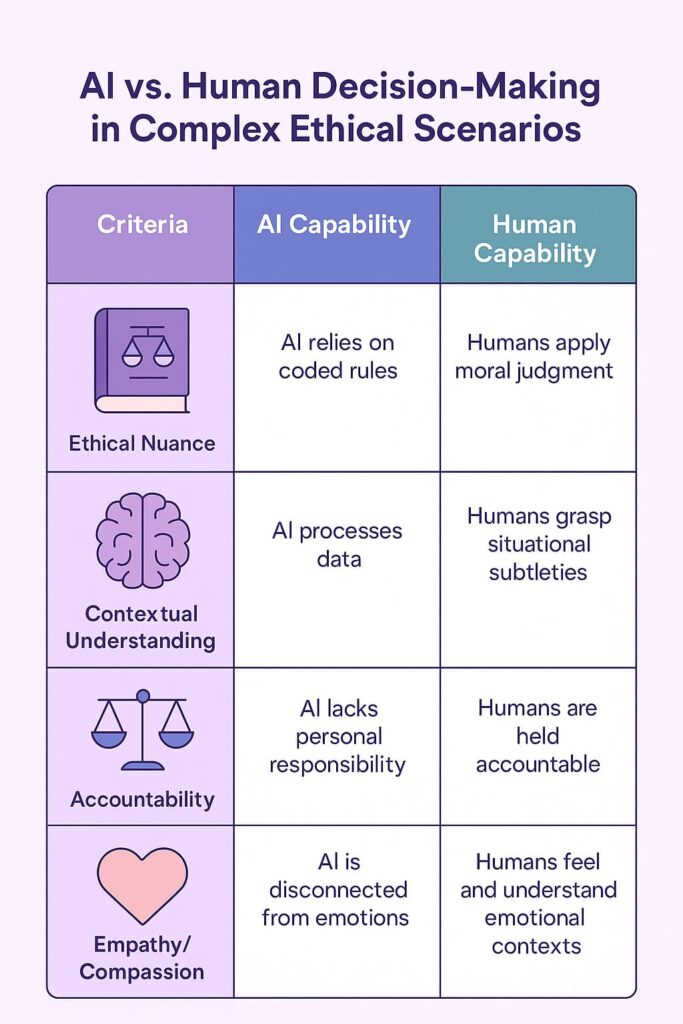
Decision-Making Showdown: Humans vs AI in High-Stakes Scenarios
Let’s put AI next to a human – both equipped to decide life-altering issues. What stands out in this clash of algorithms and emotional intelligence, you ask? A closer examination brings forth a startling clarity.
| Criteria | AI Capability | Human Capability |
| Ethical Nuance | An AI system often fails to appreciate the delicate nuances of common moral dilemmas; its decision-making pivots around rigid rules and probabilities. | Humans, on the other hand, can perceive, evaluate and navigate subtle shades of grey in ethical situations, underpinned by our unique culture and values. |
| Contextual Understanding | Due to its lack of lived experience, AI struggles to interpret and respond day-to-day context, with its myriad variables and subtleties. | Humans, drawing from a store of personal experiences, can deftly navigate context, understanding its impact on decisions. |
| Accountability | AI may churn out precise, data-backed decisions but cannot assume responsibility for outcomes; accountability in AI remains a gray area. | When a human makes a decision, accountability tags along, making humans more cautious and thoughtful, adding a credibility layer to their calls. |
| Empathy/Compassion | AI lacks the ability to empathize or show compassion – these emotional dimensions remain exclusively human. | Where machines fail, humans excel – our ability to resonate with others’ feelings, to show compassion and empathy, can guide more humane decisions. |
This table zeroes in on the significant edge humans hold over AI in high-stakes scenarios. It also reaffirms an irreplaceable element of the decision-making machinery – the human factor. Our ability to understand, empathize and be held accountable for our actions and decisions forms our unique, invaluable edge over artificial intelligence. As we begin to leverage the power of AI in various sectors, these human skills will ensure vital roles that remain firmly in our realm, shielded from the encroaching wave of automation.
A Journey to Job Security: The Human Skills AI Can’t Supplant
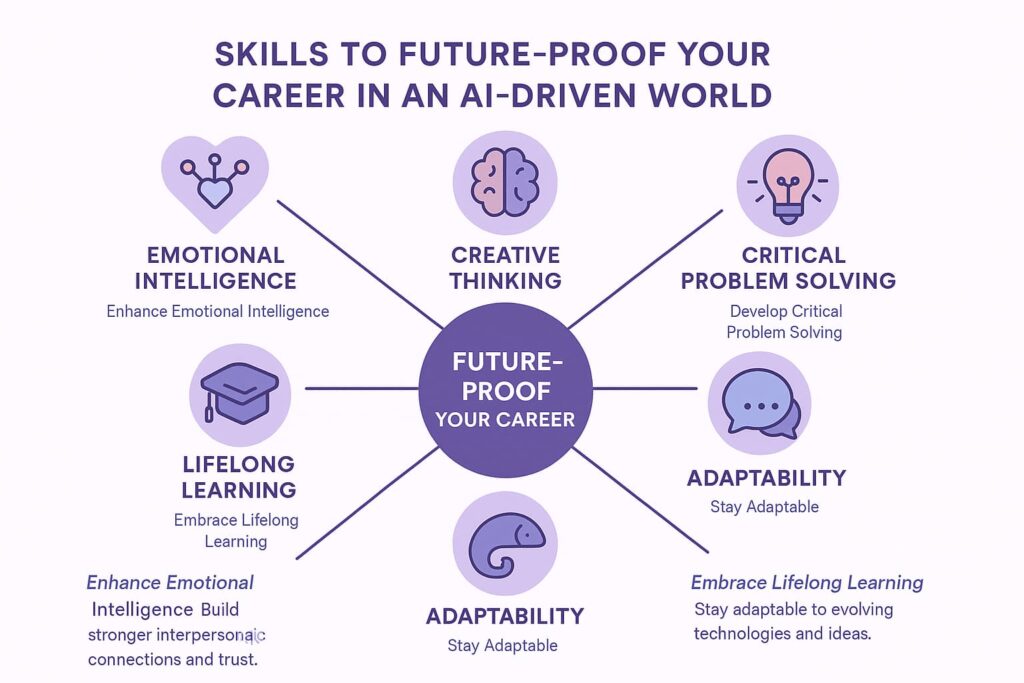
To safeguard your future in an increasingly AI-dominated landscape, focus on those intangible capabilities that algorithms cannot emulate. The human edge lies within these little expertises:
- Sharpen Your Emotional Intelligence: AI can analyse sentiments, but genuine empathy requires a human touch. Strengthen your emotional sensitivity and understanding.
- Nurture Creativity: AI may create stunning graphics, yet the spark of original artistry requires a human mind. Harness the power of your imagination.
- Hone Critical Problem-Solving: AI is excellent at systematic problem-solving, but dealing with ambiguous situations requires human cognition. Foster your ability to tackle complex challenges.
- Master Complex Communication: AI can generate communication, but to inspire and persuade demands a human voice. Improve your conversational skills and abilities to communicate abstract ideas.
- Embrace Lifelong Learning: AI can absorb vast quantities of information, but the thirst for knowledge requires human curiosity. Cultivate habits of continuous learning and growth.
- Cultivate Adaptability: AI can adapt based on new data, but resilience to life’s unexpected changes takes a human spirit. Foster flexibility and agility.
Investing in these human competencies will enhance your value in the age of AI, ensuring your role in an AI-driven future remains secure and indispensable.
Embracing AI: Together We Thrive
As we map out the landscape of our future workplaces, a collaboration between humans and AI emerges, not as a threat but as a promising partnership. Our unique human attributes – the finesse for ethical discourse, the depth of our emotional intelligence, the power of empathy – remain irreplaceable, not rendered obsolete by AI but rather, enhanced.
This AI-enabled future holds extraordinary potential if we view it through the lens of synergy, not replacement. Jobs deeply rooted in our remarkable human potential, steeped in our shared experiences and capabilities, are safe. Instead of fearing AI, let’s embrace it as an opportunity.
As a tool that amplifies our talents, enabling us to direct our focus towards what makes us uniquely human. In shaping a future that celebrates our humanity, we’ll harmonize technology’s revolutionary touch with our timeless, invaluable human spirit.